
Table of Contents
Hemorrhoids are caused by pressure, from straining, hard stools or long hours sitting, landing on a normal cushion of tissue whose support has grown weak. The pressure is the trigger, but the weak support is the reason, and it's also the answer to why do hemorrhoids keep coming back.
Maybe you eat pretty well. You drink water. And still, one morning, there it is again. You sit on one side at dinner, you keep a cream in the cabinet for next time, and you wonder what you did wrong. Probably nothing new. The same pressure you handled at 30 lands differently on tissue that has changed.
Everyone has hemorrhoidal cushions. A 2016 review from Duke University explains that trouble starts when the tissue holding them in place breaks down, and that age, straining and long sitting all add to it. Researchers at Cleveland Clinic Florida found a weaker mix of collagen in hemorrhoid tissue than in normal tissue, in their 2015 study.
What causes hemorrhoids: the cushion behind them
You were born with hemorrhoids. Not the painful kind, the normal kind. They're soft pads of blood vessels, collagen and elastic tissue just inside the opening. They fill a little, they empty, and they help seal things shut so you don't leak.
Those pads are held in place by a net of connective tissue. Harvard Health explains that this supporting tissue can weaken with age. When it does, the cushion loses its grip, slides down a little more each time you push, and the vessels inside swell. That bulge is what we call a hemorrhoid.
How hemorrhoids form
Dr. Dave Longcope, a colorectal surgeon in Denver, explains in a patient video that these vessels "have no muscle in the wall so they can easily swell or stretch out when the pressure inside them increases." Here's how it usually goes:
- You strain, sit for a long time, or pass a hard stool.
- Pressure in your belly and pelvis goes up, and the cushion fills.
- Weak support lets the cushion slide down instead of springing back.
- Stretched vessels swell, itch, or bleed a little.
- Each round leaves the support a bit looser than before.
That last step is the one nobody talks about. It explains why it gets easier to flare as the years go by.
Common causes of hemorrhoids

The NIH page on hemorrhoid causes lists the usual suspects:
- straining during bowel movements
- sitting on the toilet for a long time
- constipation or diarrhea that doesn't go away
- a diet low in fiber
- lifting heavy things often
- the supporting tissue getting weaker with age
Sitting deserves its own line. Dr. Brian Barden, a surgeon at Tanner Health in Georgia, describes a two minute rule: after two minutes on the toilet, "get up and try again later." Phones turned a short visit into a long one.
Long drives and flights work the same way. Hours in a seat, less water, a changed routine and a harder stool the next morning. Driving doesn't create hemorrhoids out of nowhere. It adds pressure to a cushion that's already losing support.
What causes hemorrhoids to come back
A flare calms down when the swelling goes away. The support underneath doesn't come back with it. So the next hard morning finds the same weak tissue, and the cushion slides again.
That's why prevention is mostly about pressure: soft stools, short bathroom visits, enough water and regular movement.
Causes people blame
Can stress cause hemorrhoids
Not directly. Stress doesn't build a hemorrhoid by itself. But stress changes your gut. It can bring on diarrhea or constipation, change what you eat and how much water you drink, and keep you sitting longer. Doctor Vinnie, a physician who answers this question in a video, says stress can cause hemorrhoids "perhaps indirectly, and that's because digestive problems are common response to stress." So if your flares follow hard weeks at work, look at what those weeks did to your bathroom habits. Change the habits, and stress loses most of its path to the cushion.
Are hemorrhoids hereditary
Hemorrhoids often show up in several people in one family, and that makes people think it's in the genes. Families share a lot more than genes, though. They share the same kitchen, the same low fiber meals, the same jobs and the same habits on the toilet. Some people may also be born with looser connective tissue. Either way, your family history doesn't decide your future. The cushion responds to what you do with it, every single day.
Can dehydration cause thin veins
When you're low on fluids, your body pulls water from wherever it can, including your stool. That's the part that matters for hemorrhoids. Less water means a harder, drier stool, more pushing and more pressure on the cushion. People also notice that their veins look flatter and harder to find when they're dehydrated. Drinking enough won't change weak tissue, but it keeps you from adding a hard morning on top of it.
What causes hemorrhoid flare ups
A flare is the moment a weak cushion gets pushed past its limit. The usual triggers are a hard stool, a bout of diarrhea, a long drive, a heavy lift, a long day in a chair, or a few days with little fiber and water. Many people also notice a flare after a cold with a lot of coughing. Each one adds pressure. On strong tissue, nothing happens. On loose tissue, the cushion swells and slides. So the trigger explains the timing. The tissue explains why it happens at all.
What causes bleeding hemorrhoids
Internal hemorrhoids sit under a thin lining. A hard stool passing over a swollen cushion can scrape that lining, and you see bright red blood on the paper or in the bowl. Dr. Gary Hoffman, a colon and rectal specialist in Los Angeles, explains in a patient video that inside hemorrhoids "there are stretch receptors and itch receptors, but no pain receptors," which is why they often bleed without hurting. Still, never assume. The American Cancer Society warns that rectal bleeding can come from other causes too. See your doctor.
Do hemorrhoids cause gas
No. Gas comes from your gut, from food and the bacteria that break it down. Hemorrhoids sit at the very end of the line and don't make gas. But the two often show up together, because the same thing feeds both: constipation. A slow, backed up gut brings gas, bloating and hard stools, and hard stools bring flares. Large internal hemorrhoids can also give you a feeling of fullness, like you're not quite done. If bloating is new or won't go away, mention it to your doctor.
Can hemorrhoids cause testicular pain
Hemorrhoids aren't a known cause of pain in the testicles. Pain in that area has other causes, and some of them need care quickly. If you have testicular pain, with or without hemorrhoids, see a doctor and don't wait for it to pass.
Sources
- Sun and Migaly, Duke University, 2016, Review of hemorrhoid disease
- Nasseri and colleagues, Cleveland Clinic Florida, 2015, collagen in hemorrhoid tissue
- Harvard Health Publishing, Hemorrhoids and what to do about them
- NIDDK (NIH), Symptoms and causes of hemorrhoids
- American Cancer Society, Signs and symptoms of colorectal cancer
- Dr Dave Longcope, The Truth About Hemorrhoids: Separating Fact from Fiction (YouTube)
- Tanner Health, Hemorrhoids: Causes, Treatments and Prevention - Brian Barden, MD (YouTube)
- Doctor Vinnie, Does STRESS really cause HEMORRHOIDS? (YouTube)
- LAColonRectal, How Long Do Hemorrhoids Last? (YouTube)
This article is for general information and is not medical advice. If you have rectal bleeding, severe pain or a change in your bowel habits, see your doctor.
About Venalys
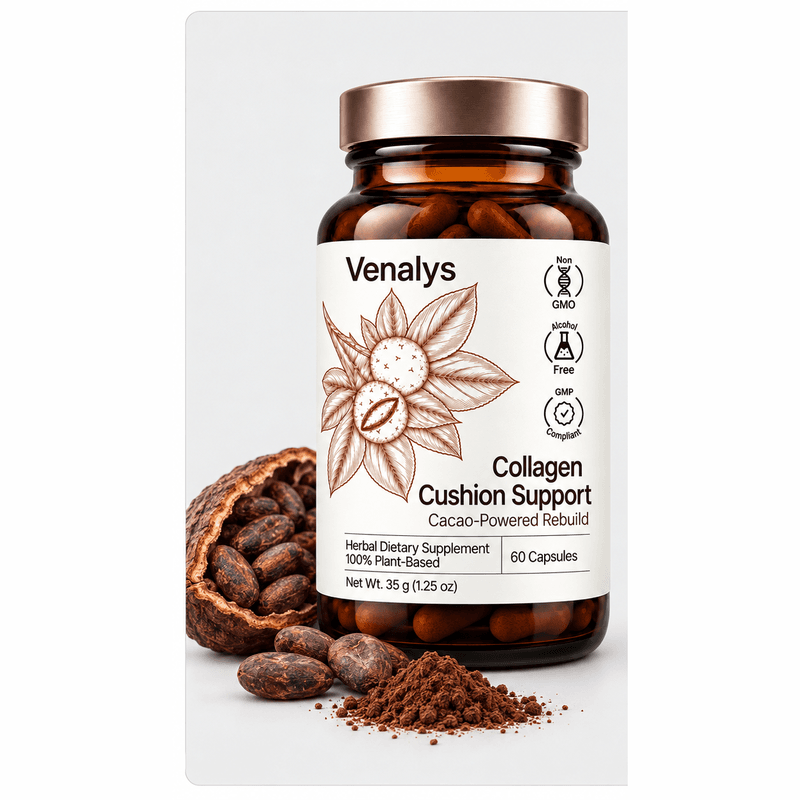
Venalys Collagen Cushion Support is a daily, plant based capsule made with cacao, horse chestnut, butcher's broom, soft psyllium and chicory root. It is formulated to support healthy vein tone and comfortable, regular bowel movements.†
Learn more about Venalys†These statements have not been evaluated by the Food and Drug Administration. This product is not intended to diagnose, treat, cure, or prevent any disease.
FAQs
What is the number one cause of hemorrhoids?
Straining on the toilet, usually from constipation, is the most common trigger. The deeper reason is support tissue that has weakened, so the cushion slides under that pressure.
What vitamin deficiency causes hemorrhoids?
There's no good evidence that a vitamin deficiency causes hemorrhoids. Low fiber and low water matter far more.
Can collagen supplements cause hemorrhoids?
There's no evidence they do. If you notice a change in your bowel habits after starting any supplement, mention it to your doctor.
Can driving cause hemorrhoids?
Long hours in a seat add pressure and often bring harder stools. Stop to walk, keep water in the car and don't push.
What causes hemorrhoids at a young age?
Mostly straining, constipation, heavy lifting and long sitting. Young tissue is stronger, so flares often fade faster.
Can hemorrhoids cause constipation and back pain?
Fear of a painful bowel movement can make you hold it, which leads to constipation. Back pain usually has other causes, so ask your doctor.
Do hemorrhoids go away on their own?
Flares often settle in days with soft stools and less sitting. The weak support stays, which is why they return.