

Table of Contents
- Why hemorrhoids keep coming back
- Do hemorrhoids keep coming back, or do they never leave?
- Hemorrhoid stages
- My hemorrhoids keep coming back for months or years
- Hemorrhoid keep coming back? What to change first
- Weak veins under the cushion
- Weak veins
- How to strengthen veins
- How to fix weakened veins
- Can you repair veins naturally
- What foods help repair veins
- What drink is good for veins
- Do vein vitamins really work
- Supplements for vein health
- Horse chestnut for veins
- How long does horse chestnut take to work
- Does cacao widen blood vessels
- How long does it take a collagen supplement to work
- Sources
- About Venalys
Hemorrhoids keep coming back because the tissue that holds the cushions in place has weakened, and the daily pressure that pushed them out is usually still there. The bulge goes quiet between flares, and the next hard morning can start it all again.
You know the pattern. A flare starts, you buy a cream, it settles, and a few weeks later you're back in the same aisle. You sit on one side, then the other. Knowing why it repeats helps you pick what to change and when to see your doctor.
Why hemorrhoids keep coming back
Everyone is born with hemorrhoidal cushions. They're normal pads of collagen, elastin and blood vessels that help seal things shut. Trouble starts when the tissue that holds them in place gets weaker. Harvard Health explains that this supporting tissue can weaken with age, so the cushions bulge and slide down.
Researchers at Cleveland Clinic Florida looked at hemorrhoid tissue under the microscope. They found a weaker mix of collagen than in normal tissue, according to their 2015 study of hemorrhoid collagen. In other words, the support around the cushions is part of the story, not just the swollen vessels.
Creams can calm itching and soreness during a flare, which is what they are made for. Meanwhile, every hard stool and every long day in a chair keeps pushing on the same tissue.
What causes hemorrhoids
Pressure is the trigger. Straining, constipation, diarrhea, heavy lifting, extra weight and long hours of sitting all push down on the cushion. On a strong cushion, that pressure does little. On a cushion that has lost its support, the vessels swell and the tissue slides. More detail in our guide to what causes hemorrhoids.
Why do I keep getting hemorrhoids
Usually it's the same daily load landing on the same weak tissue. You may eat better than most people and still get flares. Look at your mornings, your water and your sitting time. Then ask your doctor to confirm it really is hemorrhoids.
What age do you get hemorrhoids
You can get them at any adult age. They get more common in midlife, as the supporting tissue loses strength and years of pressure add up. Many people notice their first real flare in their thirties or forties and find that each one lasts a little longer than the one before.
Getting ready before the hemorrhoid years
The best time to protect the cushion is before it starts sliding. Build the habits now: enough fiber, enough water, short bathroom visits and regular walks. If you sit all day for work, stand up every hour. Small habits started early cost little and spare the tissue a lot of wear.
Do hemorrhoids keep coming back, or do they never leave?
Most of the time, each flare is the same cushion, quiet for a while, then pushed out again. So the real question is how to make the tissue stronger between flares.
Will hemorrhoids go away
The swelling of a flare often settles on its own within days or weeks. The cushion underneath doesn't vanish, because it's normal anatomy. What can change is how well it holds its place. We cover the details in our guide on will hemorrhoids go away.
Do hemorrhoids go away by themselves
Small ones often calm down with soft stools and less straining. That's the body doing its job. But "gone" and "quiet" aren't the same thing. If the same spot keeps flaring, read do hemorrhoids go away by themselves and talk to your doctor about what you're seeing.
Will an external hemorrhoid go away
External ones sit under the skin around the opening. The swelling usually goes down, but a soft flap of skin can stay behind. That leftover tag isn't dangerous, though it can be annoying to keep clean. Our page on will external hemorrhoid go away explains what's normal.
Can a thrombosed hemorrhoid go away on its own
A thrombosed hemorrhoid has a small clot inside, and it can be very painful. Many settle as the body breaks the clot down, often leaving a skin tag. If the pain is severe, call your doctor early. A doctor can sometimes relieve it quickly in the office.
How long do hemorrhoids take to shrink
It depends on the size, the type and what you change. A small flare can calm within days. A large or prolapsed one takes longer. Bigger or older hemorrhoids may need a doctor's help to settle.
How long does hemorrhoid bleeding last
Bleeding from a hemorrhoid is usually bright red and stops on its own when stools get softer. Never assume it's "just hemorrhoids" though. Any rectal bleeding, especially if it keeps coming back or the blood is dark, is a reason to see your doctor.
Hemorrhoid healing stages
Most flares follow the same arc. Swelling and tenderness, then a slow calm, then a quiet period. That quiet period is where most people stop paying attention. It's also the best time to protect the tissue.
Hemorrhoid stages
Hemorrhoids stage
The stage describes the cushion, not the pain. A doctor checks whether the tissue stays inside, comes out and goes back, or stays out. Knowing your stage helps you understand which options make sense. See our guide on hemorrhoids stage for how a doctor decides.
The 4 stages of hemorrhoids
Stage 1 bulges inside but doesn't come out. Stage 2 comes out when you strain and goes back on its own. Stage 3 comes out and you push it back. Stage 4 stays out. Each step means the support has slipped a bit further. More in 4 stages hemorrhoids.
Stage 1 hemorrhoid
This is the earliest stage. You may notice a little bright red blood or some itching, but nothing comes out. It's the stage where daily habits matter most, because the cushion still holds. Get any bleeding checked, then focus on soft stools and less pressure.
My hemorrhoids keep coming back for months or years
Can hemorrhoids last for months
Yes. A swelling that hangs on for weeks, or a cycle that flares every month, is common when the pressure doesn't change. If it's been more than a few weeks with no improvement, see your doctor. Something else may be going on, and there are office options.
Hemorrhoids that won't go away
When a lump stays put, it's usually a prolapsed cushion or a leftover skin tag. Neither goes away with home care alone. A doctor can tell you which it is and whether a simple office procedure makes sense for you.
Can hemorrhoids last for years
They can, as a pattern of flares and quiet spells. Many people live with that cycle for a decade. As long as the daily pressure stays the same, the cycle tends to keep going.
Can you have hemorrhoids for years
You can carry a slightly slipped cushion for years without big symptoms, then flare after a long road trip. What you do between flares shapes the next one.
Do hemorrhoids stay with you for life
The cushions do, because everyone has them. The problem doesn't have to. With less daily pressure, many people go long stretches without a flare. A doctor can also tell you which office options fit your stage.
Is it okay to leave hemorrhoids untreated
Mild hemorrhoids that don't hurt often need only home care. Get a diagnosis first, because other conditions can look the same. Bleeding, a growing lump or pain that won't settle means a visit to your doctor.
Can you leave a thrombosed hemorrhoid untreated
Many do settle without a procedure, but the pain can be intense for a while. If it's severe, or it's getting worse instead of better, call your doctor. Waiting it out is a choice to make with them, not alone.
Why don't doctors like to remove hemorrhoids
Surgery works for advanced cases, but recovery can be painful and slow. The cushions also have a job: helping seal things shut. So most doctors start with fiber, water and office procedures first.
Hemorrhoid keep coming back? What to change first

How to make a hemorrhoid go away
For a flare: soft stools, short bathroom visits, warm sitz baths and gentle cleaning. Don't strain and don't sit there scrolling. If it's still bad after a week, or you're bleeding, see your doctor. Our guide on how to make hemorrhoid go away walks through each step.
Hemorrhoid lifestyle changes
Fiber comes first. The surgeons' guideline found that fiber cuts symptoms that stick around by about half, as summarized in the American Family Physician summary of the 2024 ASCRS guideline. Add water, a daily walk and a stool under your feet in the bathroom.
How to prevent hemorrhoid bleeding
Bleeding usually comes from hard stool scraping the swollen cushion. Softer stools are the biggest lever. A gentle fiber like psyllium helps a lot of people. Still, any bleeding needs a doctor's look first, so you know it's really coming from a hemorrhoid.
Weak veins under the cushion
Weak veins
"Weak veins" usually means vessels that stretch and pool blood instead of pushing it along. You see it in the legs as varicose veins. Under the cushion, the same pooling makes a flare swell faster. The vessel is only part of the story, though. The support around it matters just as much.
How to strengthen veins
Move. Walking helps your leg muscles push blood back up. Don't sit for hours without a break, and don't strain in the bathroom. These habits help vessels everywhere.
How to fix weakened veins
A vessel that has stretched a lot doesn't snap back on its own. For legs, doctors have procedures. For hemorrhoids, the everyday goal is less pressure, so the vessels have less reason to swell.
Can you repair veins naturally
You can help them work better with movement, fiber, water and less sitting. Some plant extracts have been studied for leg veins. Be wary of any product that makes big promises.
What foods help repair veins
Fiber rich foods like beans, oats, berries and greens keep stools soft, which takes pressure off. Fruits and vegetables also bring flavonoids, plant compounds linked to healthy vessels. Variety matters more than any single food.
What drink is good for veins
Water, first. It keeps stools soft. Some people like cacao or green tea for their flavonoids. Most cocoa drinks, though, use processed cocoa that has lost most of them.
Do vein vitamins really work
Some ingredients have decent evidence for leg vein symptoms. Few have been tested on hemorrhoids directly. Read what each ingredient was actually studied for, and ask your doctor before adding one.
Supplements for vein health
The common ones are flavonoids, horse chestnut and butcher's broom. Read the label for doses and for how long you're meant to take it. Ask your doctor or pharmacist before starting one, especially if you take other medicines.
Horse chestnut for veins
Horse chestnut seed extract has been studied for vein problems in the legs. The Memorial Sloan Kettering herb guide on horse chestnut says short trials support it there, but there's no data yet for hemorrhoids. Raw seeds are toxic, so the studies used a standardized extract.
How long does horse chestnut take to work
The studies on leg veins ran for weeks, not days. None of them looked at hemorrhoids. If you take blood thinners, ask your doctor first, because horse chestnut may raise bleeding risk.
Does cacao widen blood vessels
Cacao flavanols help blood vessels relax in lab and human studies. Here's the catch. Most cocoa is Dutch processed, meaning alkalized, and a Hershey study of alkalized cocoa powders found that step strips out most of the flavanols, up to about 90 percent. Studies on cacao and vessels have not looked at hemorrhoids.
How long does it take a collagen supplement to work
Collagen powder is broken down into amino acids when you digest it. Studies on collagen supplements have mostly looked at skin and joints, over weeks to months. No study has tested collagen supplements for hemorrhoids.
Sources
- Harvard Health Publishing, Hemorrhoids and what to do about them
- Nasseri and colleagues, Cleveland Clinic Florida, 2015, collagen in hemorrhoid tissue
- American Family Physician, 2025 summary of the ASCRS hemorrhoid guideline
- Memorial Sloan Kettering Cancer Center, Horse chestnut
- Miller and colleagues, Hershey, 2008, alkalization and cocoa flavanols
This article is for general information and is not medical advice. If you have rectal bleeding, severe pain or a change in your bowel habits, see your doctor.
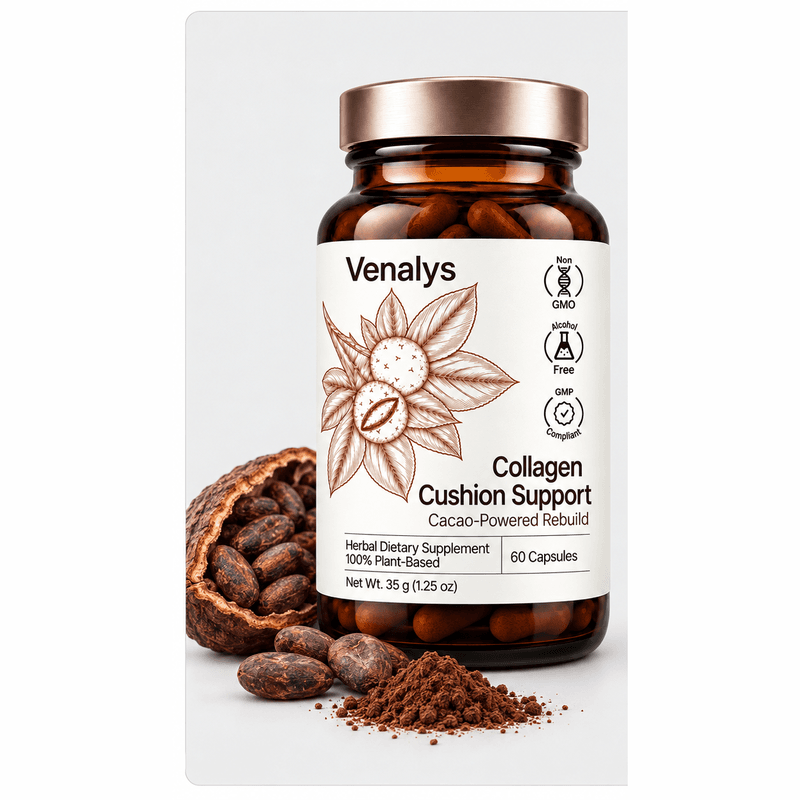
About Venalys
Venalys Collagen Cushion Support is a daily, plant based capsule made with cacao, horse chestnut, butcher's broom, soft psyllium and chicory root. It is formulated to support healthy vein tone and comfortable, regular bowel movements.†
Learn more about Venalys†These statements have not been evaluated by the Food and Drug Administration. This product is not intended to diagnose, treat, cure, or prevent any disease.
FAQs
How often do hemorrhoids come back?
It varies a lot. Some people flare once and never again. Others flare every few weeks. It depends a lot on daily pressure, like straining, constipation and long sitting.
Do hemorrhoids come back in the same spot?
Often, yes. The cushions sit in the same places, so the weakest one tends to flare again. A new lump in a new place, or one that grows, is worth showing your doctor.
Can internal hemorrhoids come and go for years?
Yes. Internal hemorrhoids often swell, settle, then swell again. That's also why the pain comes and goes. It tracks the swelling, not a new problem each time.
Can hemorrhoids come back after surgery or a laser procedure?
They can. A procedure removes or shrinks the bulge you have now. It doesn't change the daily habits that added pressure. That's why doctors stress fiber and water after any procedure.
Is it normal for a hemorrhoid to keep coming back?
It's common, but don't ignore it. A repeating cycle often means the daily pressure is still there. Get a diagnosis, then work on fiber, water and bathroom habits.