

Table of Contents
A collagen supplement is animal collagen cut into small pieces, called peptides, and sold as a powder, capsules, gummies or a drink. Most people take one for skin, joints, hair or nails. If you got here because of hemorrhoids, our guide to collagen for hemorrhoids explains what the research does and doesn't show.
Maybe you've stood in the supplement aisle and stared at a wall of tubs. Bovine, marine, types I and III, "high absorption." They all look the same, and they all cost more than you'd like. So let's sort out what you're choosing between.
Here's why the topic comes up for people with hemorrhoids. The cushions that bulge are partly made of collagen. A 2015 study from Cleveland Clinic Florida found that hemorrhoid tissue had less of the strong type I collagen, compared with the more stretchy type III. Harvard Health explains that the tissue supporting those cushions can weaken with age. But no study has tested a collagen supplement for hemorrhoids, so keep that in mind as you read.
Collagen as a dietary supplement
Is collagen a supplement? Yes. In the US, collagen powders and capsules are sold as dietary supplements, not as drugs. That means nobody had to prove they work before they hit the shelf.
Dr. Andrea Suarez, a dermatologist who posts as Dr Dray, puts it plainly: "dietary supplements are not regulated for purity like medications." So the quality of what's in the tub depends a lot on the company that makes it.
Collagen also shows up in regular food, like bone broth, chicken skin and fish with the skin on. A collagen food supplement is just a more concentrated, processed version. And your body makes its own collagen every day. That production drops with age, at least in skin, as a University of Michigan study showed. How your body makes collagen, and what helps it, is a topic of its own.
Collagen supplement sources: animal based options

Almost every collagen supplement comes from an animal. Dr. Sarah Sheu, a dermatologist, sums it up: "Most are derived from animal sources like the bones, skin, tendons, and cartilage of cows and pigs."
Here's what you'll see on labels:
- Bovine collagen. From cow hides and bones. It's the kind you'll see most often.
- Porcine collagen. From pig skin.
- Marine collagen. From fish skin and scales. A good pick if you don't eat beef or pork, but not if you're allergic to fish.
- Chicken collagen. Usually from cartilage, and often sold for joints.
- Eggshell membrane. The thin film inside an egg. It shows up in some joint products.
What about "vegan collagen"? Plants don't make collagen. So these products don't contain any. They're usually a mix of amino acids and vitamin C meant to help your body make its own.
Bone broth and gelatin aren't the same as a supplement either. Dr. Suarez points out that neither one is broken down into the small peptides you find in a collagen powder.
Types I, II and III on the label
Your body has many kinds of collagen. Labels usually list three of them:
- Type I. The strong, dense kind found in skin, tendons and bone. It's the type most skin products focus on.
- Type II. The kind found in cartilage, the padding in your joints. Joint products often use it.
- Type III. A more stretchy kind found with type I in skin, blood vessels and soft tissue.
The Cleveland Clinic Florida study above looked at this exact mix of type I and type III in hemorrhoid tissue. But a label that says "types I and III" doesn't send those types anywhere special. Your gut breaks the peptides down further, and your body uses the pieces where it needs them.
Powder, capsules, gummies or liquid
Dr. Sheu describes the market this way: "Collagen supplements typically come in powder form, capsules, or in liquid form, and most are hydrolyzed collagen peptides, which means that the collagen is broken down into smaller pieces."
The form mostly changes three things: how much you get, how easy it is to take, and what else comes along with it.
| Form | What's good about it | What to watch |
|---|---|---|
| Powder | Cheapest per serving, easy to measure, mixes into coffee or a smoothie | Taste, and some add sugar or flavors |
| Capsules | No taste, easy to travel with | You may need several to match one scoop |
| Gummies | Easy to remember, taste good | Often little collagen per gummy, plus sugar |
| Liquid | Ready to drink | Price, and sweeteners |
"Powders are the cheapest option, and they give you the most control over how much you're taking," says Dr. Sheu. With capsules, she adds, one serving can mean swallowing a handful.
You'll also see combo products, like collagen with silica, collagen with omega-3 fish oil, or collagen with vitamin C. A combo isn't better by default. It just makes it harder to tell what's doing what.
What to look for in a collagen supplement
There's no single collagen supplement that works for everyone. But a few checks will help you avoid paying for marketing.
- The source animal. If you avoid fish, beef or pork for health or faith reasons, start here. Dr. Sheu calls this "the easiest and most important factor."
- Collagen per serving. Look at the grams of collagen, not the size of the tub. Gummies and capsules can hold much less than a scoop of powder.
- Third party testing. A seal from an independent testing group means someone outside the company checked what's inside.
- Short ingredient list. Collagen peptides, maybe vitamin C. Long lists of extras mostly raise the price.
- "Bioavailable" or "high absorption" claims. Most powders are already hydrolyzed, so these words often describe something every product does.
- Mega doses of extras. Many hair, skin and nail blends add a lot of biotin. Dr. Sheu warns that "these crazy high amounts of biotin can actually interfere with certain lab tests." If you get blood work, tell your doctor what you take.
How much is too much
Labels vary a lot, and a high dose collagen supplement isn't proven to work better than a modest one. Dr. Sheu, who reviewed the studies for her own use, says "taking more than you need to increases the cost and potential for GI upset like bloating."
So follow the label, or ask your doctor. Don't double up hoping for faster results. And remember that collagen is protein. If you have kidney problems or have been told to watch your protein, check with your doctor before you add a daily scoop.
Collagen supplement pros and cons
| Pros | Cons |
|---|---|
| Usually well tolerated | Results are modest and mostly studied in skin and joints |
| Easy to add to a drink you already have | It costs money every month, with no clear end point |
| Adds a bit of protein to your day | Quality depends on the maker |
| Many forms to fit your routine | Not an option for some allergies or diets |
Does a collagen supplement work? The evidence on results is a topic of its own, and we cover the benefits separately. As for side effects, most people only notice a full stomach or an odd taste, though an allergy to the source animal can happen. If you're allergic to fish, skip marine collagen.
Who takes collagen supplements
Most people who buy collagen fall into a few groups:
- People who care about their skin, often in their 40s and up.
- People with stiff or achy joints, who often pick type II or chicken collagen.
- Active people and lifters, who use it as a light protein boost.
- Older adults, since the body makes less collagen with age.
What about a collagen supplement after surgery, or for a meniscus tear? Ask your surgeon first. Your needs can change while you recover.
And if hemorrhoids are what brought you here, the daily pressure on the cushions matters more than any tub. Soft stools from fiber and water, short bathroom visits and getting up from your chair often all lower that pressure. If flares keep coming back, or you see bleeding, see your doctor.
Sources
- Nasseri and colleagues, Cleveland Clinic Florida, 2015, collagen in hemorrhoid tissue
- Harvard Health Publishing, Hemorrhoids and what to do about them
- Varani and colleagues, University of Michigan, 2006, collagen in aged skin
- Dr. Sarah Sheu, Dermatologist: Do Collagen Peptides REALLY WORK for Anti-Aging? (YouTube)
- Dr. Sarah Sheu, Dermatologist: I Took Collagen Peptides for 2 Years. Here's What Actually Happened (YouTube)
- Dr Dray, Collagen Supplements EXPLAINED by a Derm (YouTube)
This article is for general information and is not medical advice. If you have rectal bleeding, severe pain or a change in your bowel habits, see your doctor.
About Venalys
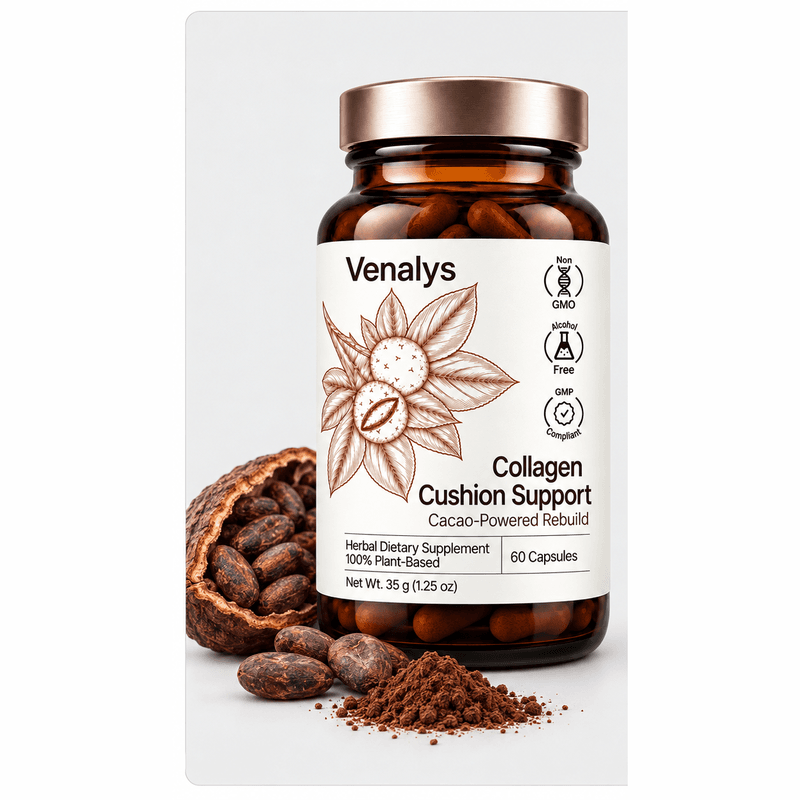
Venalys Collagen Cushion Support is a daily, plant based capsule made with cacao, horse chestnut, butcher's broom, soft psyllium and chicory root. It is formulated to support healthy vein tone and comfortable, regular bowel movements.†
Learn more about Venalys†These statements have not been evaluated by the Food and Drug Administration. This product is not intended to diagnose, treat, cure, or prevent any disease.
FAQs
What does a collagen supplement do?
It gives your body collagen peptides, which your gut breaks down and uses where your body needs them. Most studies look at skin and joints. No study has tested it for hemorrhoids.
Do I need a collagen supplement?
Most people don't need one. Your body makes collagen from the protein and vitamin C in a normal diet. A supplement is a choice, not a must.
Is collagen a good supplement?
It's generally well tolerated, and some people like it for skin or joints. The research is modest, and quality varies by brand. Pick one with a clear source and third party testing.
How is a collagen supplement made?
Makers take animal hides, bones, scales or cartilage and break the collagen down with water, heat and enzymes. The result is dried into a powder of small peptides. That powder then goes into tubs, capsules, gummies or drinks.
Which food is highest in collagen?
Collagen is found in the tough parts of animals. Bone broth, chicken skin, pork skin and fish with the skin on are good examples. Plants don't contain collagen.
Should older adults take collagen?
Age alone isn't a reason to start. If you're curious, talk with your doctor, especially if you take several medicines or have kidney problems. A balanced diet with enough protein comes first.