
Table of Contents
Collagen matters for hemorrhoids because the cushion that bulges is held together by collagen, and hemorrhoid tissue carries a weaker kind of it. But swallowed collagen is broken down before it's absorbed, and no study has tested collagen powder for hemorrhoids. If you're comparing options, start with what's known about each hemorrhoid supplement ingredient.
Maybe you already stir a scoop of collagen into your coffee every morning. Your nails look better. Your knees feel fine. And you still shift your weight in the car on long drives, one side, then the other. So it's fair to ask what the powder actually does, and what the research says about hemorrhoids.
Why collagen matters for hemorrhoids
Everyone is born with hemorrhoidal cushions. They're normal pads made of collagen, elastin and small blood vessels. Duke surgeons explain in their review of hemorrhoid anatomy that trouble starts when the tissue holding these cushions in place breaks down, and the cushions slide.
Harvard Health adds that this supporting tissue can weaken with age. And collagen production itself drops as we get older, at least in skin, as a University of Michigan study of aging skin showed.
Now look at the cushion itself. Surgeons at Cleveland Clinic Florida compared hemorrhoid tissue with normal tissue in a 2015 study on collagen in hemorrhoids. The hemorrhoid samples had less of the strong type I collagen compared with the more stretchy type III. The authors concluded the tissue seems less stable. Interestingly, they found no difference by age.
That helps explain why the same spot can flare again and again. Hard stools and long hours in a chair keep pushing on tissue whose support is already weaker, even when each flare calms down on its own.
Can't I just take collagen powder?
It's the first question almost everyone asks. If the cushion is short on good collagen, why not swallow more of it?
Because your gut doesn't ship collagen anywhere in one piece. Powder gets broken down into amino acids and small fragments. Those go into your blood and get used wherever your body decides: skin, joints, hair, muscle. Almost nothing is sent to the cushion on purpose.
Some doctors point out that a few small collagen fragments may act like a nudge to skin cells. That's been studied in skin. Nobody has tested it in the cushion.
What helps the cushions day to day
If powder isn't the answer, what can you do? The part you control is the daily pressure on the cushions.
That pressure comes from a few habits. Hard stools, straining, and long hours sitting all push the cushion down. So the basics still matter:
- Soft stools, from fiber and water, so you don't have to push.
- Short bathroom visits. No scrolling on your phone while you sit.
- Getting up from your chair every hour or so, even for a minute.
- A walk most days, which keeps your bowels moving.
These habits take time. They lower the pressure that brings flares on. If flares keep coming back anyway, see your doctor about the next step.
Collagen supplement basics
Collagen supplement
A collagen supplement is one of the most bought products in any drugstore aisle. People take it for skin, joints, hair and nails. It's mostly protein, sold as powder, capsules, gummies or drinks. For hemorrhoids, the question isn't whether collagen is good for you. It's where it ends up. A general supplement spreads its building blocks across your whole body, with no special route to the cushion. Read our full guide to collagen supplement.
What is a collagen supplement
Collagen is the main protein in your connective tissue, the stuff that holds skin, tendons and blood vessels together. A collagen supplement is that protein taken from animals and processed so it dissolves. Most labels say "hydrolyzed" or "collagen peptides". That just means the long protein was cut into shorter pieces. Your gut cuts it down even further before anything gets absorbed. Read our full guide to what is collagen supplement.
Where does collagen supplement come from
Almost all collagen supplements come from animals. Cow hides give bovine collagen. Pig skin gives porcine collagen. Fish skin and scales give marine collagen. Some products use chicken cartilage or eggshell membrane. Here's a fact many labels skip. There's no plant that makes collagen. So a "vegan collagen" product contains no collagen at all. It's usually a mix of amino acids and vitamin C meant to help your body build its own.
Collagen supplement ingredients
Read the back of the tub, not the front. Besides collagen peptides, you'll often find vitamin C, hyaluronic acid, biotin, flavors and sweeteners. Some powders add sugar. Check the amount of collagen per serving and the source animal. A long list of extras doesn't make a product better. It mostly makes it harder to tell what's doing what.
Natural collagen supplement
"Natural" usually means collagen from food or a powder with few added ingredients. Bone broth, chicken skin and fish with the skin on all contain collagen. They're real food, and that's fine. But they get digested the same way powder does, into amino acids. Natural sources feed your body in general. They don't send anything special to the cushion.
Collagen and elastin supplements
Your cushion needs more than collagen. Elastin gives it the stretch to fill and empty, a bit like a rubber band. Some products now add elastin or elastin peptides. There's very little research on swallowing elastin, and none on the cushion.
What collagen supplements can and can't do
Collagen supplement benefits
The best studied benefits are in skin, with some studies on joints and bone. Many of those trials were small and short. A dermatologist who reviewed them on video pointed out that a lot were paid for by the companies selling collagen. That doesn't make them wrong. It does mean you should keep expectations modest. None of them looked at hemorrhoids. Read our full guide to collagen supplement benefit.
Supplements for collagen production
Your body makes its own collagen every day. To do that, it needs protein and vitamin C. Without vitamin C, the body can't build healthy collagen, which is why sailors with scurvy had wounds that wouldn't close. Eating enough protein, getting vitamin C from fruit and vegetables and not smoking all help your body make collagen. For the cushions, soft stools and less straining matter most. Read our full guide to supplement collagen production.
Collagen supplement for hypermobility
Hypermobility means joints that bend further than usual. In some people it comes from a genetic difference in how their collagen is built. A collagen supplement can't change your genes or swap out the collagen you were born with. If you're very flexible and also deal with hemorrhoids or other tissue problems, talk with your doctor. It's worth knowing what's behind it.
How to take collagen
Collagen supplement dose
Labels vary a lot. Some suggest a small scoop, others suggest several. Most skin studies used modest daily amounts, and there's no strong proof that taking more works better. If you take collagen, follow the label and don't double up hoping for faster results. And no study has looked at collagen doses for hemorrhoids.
When to take a collagen supplement
Morning, night, empty stomach, with food... you'll read every possible answer online. No good study shows that the time of day changes much. What matters more is taking it the same way each day, with enough water. If a powder upsets your stomach, take it with a meal.
Daily collagen supplement
Most collagen products are meant to be taken every day. Before you start a daily habit, ask what you expect it to change and how you'll know. For skin, there's some research to guide you. For hemorrhoids, there isn't any yet.
Side effects and safety
Collagen supplement side effects
Collagen is generally well tolerated. The most common complaints are a full or bloated stomach, heartburn and an odd aftertaste. People allergic to fish or shellfish should skip marine collagen. People avoiding beef or pork for health or faith reasons should check the source. If something feels off, stop and talk with your doctor or pharmacist. Read our full guide to collagen supplement side effect.
Can a collagen supplement cause constipation
It can, for some people. Collagen is protein with no fiber. If a collagen shake replaces breakfast, you may lose fiber and water from your day without noticing. Harder stools mean more straining, and straining is hard on the cushion. Keep fiber and water steady, and choose the soft kind of fiber, not the scratchy kind.
Can a collagen supplement cause diarrhea
Some people do get loose stools, often from added sweeteners like sugar alcohols, from a big serving all at once, or from a sensitive gut. Diarrhea is rough on the cushion too, because frequent trips irritate the tissue. Try a smaller serving or a plain powder. If loose stools last more than a few days, see your doctor.
Collagen supplement safety
The FDA doesn't approve dietary supplements before they're sold, so quality depends on the maker. Look for the source animal and the dose on the label. And if you take blood thinners or have kidney problems, ask your doctor before adding any protein supplement.
Sources
- Sun and Migaly, Duke University, 2016, Review of hemorrhoid disease
- Harvard Health Publishing, Hemorrhoids and what to do about them
- Nasseri and colleagues, Cleveland Clinic Florida, 2015, collagen in hemorrhoid tissue
- Varani and colleagues, University of Michigan, 2006, collagen in aged skin
This article is for general information and is not medical advice. If you have rectal bleeding, severe pain or a change in your bowel habits, see your doctor.
About Venalys
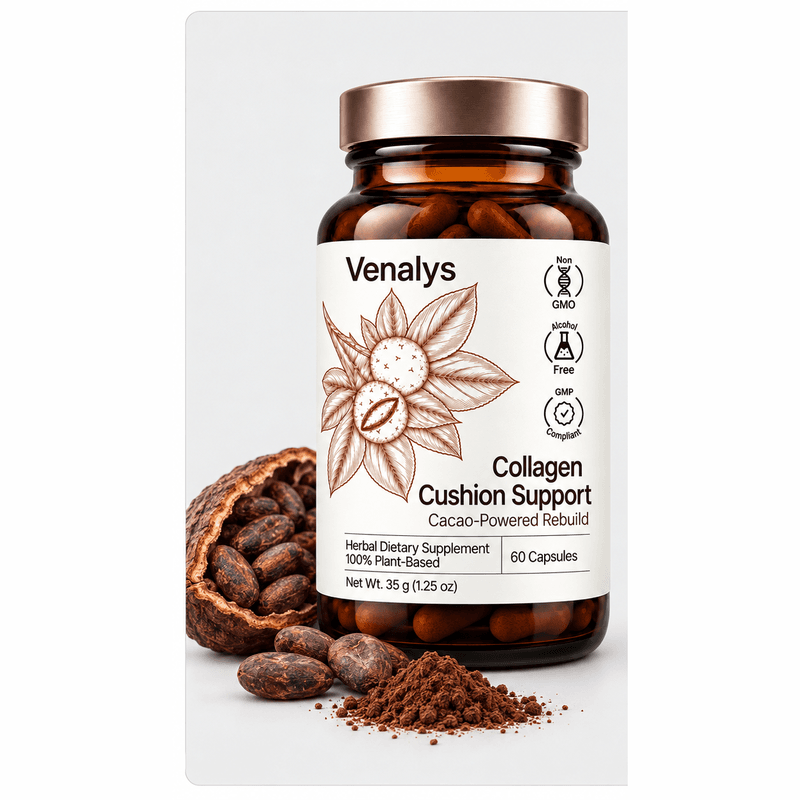
Venalys Collagen Cushion Support is a daily, plant based capsule made with cacao, horse chestnut, butcher's broom, soft psyllium and chicory root. It is formulated to support healthy vein tone and comfortable, regular bowel movements.†
Learn more about Venalys†These statements have not been evaluated by the Food and Drug Administration. This product is not intended to diagnose, treat, cure, or prevent any disease.
FAQs
Can collagen supplements cause hemorrhoids?
There's no evidence that collagen itself causes hemorrhoids. But if a collagen shake leaves you constipated and straining, that pressure is hard on the cushion. Keep your fiber and water up.
Does collagen help hemorrhoids?
No study has shown that swallowing collagen helps hemorrhoids. The cushion does depend on collagen, but powder gets broken down and spread across the body. Fiber, water and less straining have much better evidence.
Is collagen good for your veins?
Blood vessel walls do contain collagen, and some brands say their powder supports veins. There's no good evidence that swallowing collagen changes the vessels in the cushion. The same problem applies. Your body decides where the amino acids go.
Are collagen gummies or capsules better than powder?
The format changes how much you get, not where it goes. Gummies and capsules often hold much less collagen per serving than a scoop of powder, and gummies add sugar. Either way, it's digested the same way.
What supplement is best for hemorrhoids?
Fiber is the first thing surgeons recommend, because softer stools mean less straining. Flavonoids can help some symptoms during a flare. If yours keep coming back, talk with your doctor about the next step.
What shrinks hemorrhoids fast naturally?
For quick comfort, warm sitz baths, soft stools, short bathroom visits and not straining help most. Supplements work over weeks and months, not hours.
When should I see a doctor?
See your doctor if you have bleeding, severe pain, a lump that doesn't go away or any change in your bowel habits. Don't assume bleeding is just hemorrhoids.