

Table of Contents
A collagen supplement is protein taken from animal skin, bones or fish scales, then cut into small pieces so it dissolves in a drink. Once you swallow it, your gut breaks it down even more, into amino acids your body uses wherever it wants. If you came here from reading about collagen for hemorrhoids, this page explains what's actually in the tub before you decide anything.
Maybe you already stir a scoop into your morning coffee. Maybe a friend swears by it. Then you turn the tub around and read "hydrolyzed bovine collagen peptides, types I and III," and you're not sure what any of it means. Let's take it one word at a time.
What a collagen supplement is
Start with collagen itself. It's a protein your body makes on its own. Think of it as the rope that holds things together. It's in your skin, bones, tendons, cartilage and blood vessel walls.
Scientists have named many types of collagen. They're numbered with Roman numerals. Type I is the most common in your body, and it's the tough kind found in skin, bone and tendons. Type III is a bit more stretchy and sits alongside it in skin and blood vessels. You'll see those same numbers on supplement labels.
It's also in the hemorrhoidal cushions. Everyone has these. They're normal pads of tissue and small blood vessels inside the anal canal. Surgeons at Duke University explain in their review of hemorrhoid disease that trouble starts when the tissue holding these cushions in place breaks down, and the cushions slide. That's one reason people with hemorrhoids end up asking about collagen.
A collagen supplement is collagen from an animal, processed so you can eat or drink it. It's sold as powder, capsules, gummies and ready made drinks. Underneath the different packages, it's mostly the same thing: animal protein, cut into short pieces.
Where collagen supplements come from

Every collagen supplement on the shelf starts with an animal. The label usually tells you which one:
- Bovine: from cow hides and bones.
- Porcine: from pig skin.
- Marine: from fish skin and scales.
- Chicken: often from cartilage, sold as type II.
- Eggshell membrane: the thin film inside an eggshell.
Dr. Sam Ellis, a board certified dermatologist in Northern California, puts it simply in his video on oral collagen: "oral collagen supplements are not vegan." Plants don't make collagen. As he says, "if you hear something about vegan collagen that is not a thing right now." Products sold as vegan collagen usually contain amino acids and vitamin C, meant to give your body the parts it uses to make its own.
Food has collagen too. Bone broth, chicken skin, fish cooked with the skin on and tough cuts of meat like pot roast all contain it. A supplement is basically the same material, taken from the parts of the animal people don't usually eat, and cleaned up.
How a collagen supplement is made
The process sounds industrial because it is. The steps vary by company, but most follow the same path:
- The raw material (hides, bones or fish skin) is cleaned and soaked.
- It's cooked in hot water. That pulls the collagen out as gelatin, the same stuff that makes a gelatin dessert set.
- Enzymes cut the long gelatin chains into much shorter pieces. This step is called hydrolysis. The short pieces are the "peptides" on the label.
- The liquid is filtered, dried and ground into a fine powder.
- That powder goes into tubs, capsules, gummies or drinks.
So the three collagen products you see most often are close cousins. Here's how they differ:
| Product | What it is | In a cold drink |
|---|---|---|
| Gelatin | Collagen cooked out of skin and bones, in long chains | Thickens and sets as it cools |
| Collagen peptides (hydrolyzed collagen) | Gelatin cut into short pieces | Dissolves and stays liquid |
| Bone broth | Bones simmered at home or in a factory | Amount of collagen varies a lot by batch |
That's why peptides took over the supplement aisle. They mix into coffee without turning it into jelly.
What a collagen supplement is made of: reading the label
Turn the tub around and look at the Supplement Facts panel. Here's what the common words mean:
- Collagen peptides or hydrolyzed collagen: the main ingredient, listed in grams per serving.
- Bovine, porcine, marine: the animal it came from.
- Type I, II, III: the kind of collagen. Types I and III come mostly from skin and bone. Type II comes from cartilage.
- Multi collagen: a blend of several animals or types in one tub.
- Other ingredients: often vitamin C, hyaluronic acid, biotin, flavors and sweeteners.
Here's a detail most labels leave out. Dr. Sarah Sheu, a dermatologist, notes that the amino acid mix can change with the animal and with the tissue used, skin or cartilage. She adds that most brands don't say which tissue they used. So two tubs with the same grams per serving aren't always the same product.
If you're past the "what is it" stage and comparing tubs, our guide to the collagen supplement aisle covers forms, doses and what to look for.
What happens after you swallow it
This is the part that surprises most people. The collagen you swallow doesn't travel through your body as collagen.
Dr. Sheu describes the peptides in a tub as "Basically, pre-digested little bits of collagen." Then your gut keeps going. In her words, "When you take collagen supplements, they're broken down into even smaller pieces, amino acids, in your gut."
Those amino acids and a few small fragments pass into your blood. From there, your body uses them wherever it needs protein: skin, muscle, joints, and every other tissue. You don't get to pick. A scoop in your coffee has no special route to your face, your knees or anywhere else.
It also helps to know what isn't made of collagen. Dr. Ellis reminds viewers that hair and nails are made of keratin, a different protein. So when a tub promises "hair, skin and nails," those three don't work the same way.
What people take it for
Most people buy collagen for skin, joints, hair and nails. Older adults often start because they've heard collagen drops with age. That part is true, at least in skin. A University of Michigan study found that skin cells from people over 80 made less collagen than cells from young adults.
Whether a supplement changes that is a different question. Most of the research looks at skin, with some on joints. Many trials are small, and Dr. Sheu points out that a lot of them were funded by the companies selling collagen. The full picture, study by study, is on our page about collagen supplement benefit. Side effects, like a full stomach or changes in your bowel habits, get their own page too.
Where hemorrhoids fit in
So why does collagen keep coming up with hemorrhoids? Because the cushions depend on it.
Harvard Health explains that the tissue supporting the cushions can weaken with age. And a 2015 study from Cleveland Clinic Florida compared hemorrhoid tissue with normal tissue. The hemorrhoid samples had less of the strong type I collagen compared with the more stretchy type III. The study found no difference by age, and it can't tell us what came first.
It's easy to jump from there to "I'll just swallow more collagen." But you just read what happens to it. It's broken down and spread across your whole body. No study has tested a collagen supplement for hemorrhoids.
What you can control is the daily pressure on the cushions. Soft stools from fiber and water, short bathroom visits and getting up from your chair every hour all take some load off. If flares keep coming back, or you see any bleeding, talk to your doctor.
Sources
- Sun and Migaly, Duke University, 2016, review of hemorrhoid disease
- Harvard Health Publishing, Hemorrhoids and what to do about them
- Nasseri and colleagues, Cleveland Clinic Florida, 2015, collagen in hemorrhoid tissue
- Varani and colleagues, University of Michigan, 2006, collagen in aged skin
- Dr. Sam Ellis, Can Oral Collagen Supplements Improve Your Skin, Hair, & Nails? Dermatologist Explains (YouTube)
- Dr. Sarah Sheu, Dermatologist: Do Collagen Peptides REALLY WORK for Anti-Aging? (YouTube)
This article is for general information and is not medical advice. If you have rectal bleeding, severe pain or a change in your bowel habits, see your doctor.
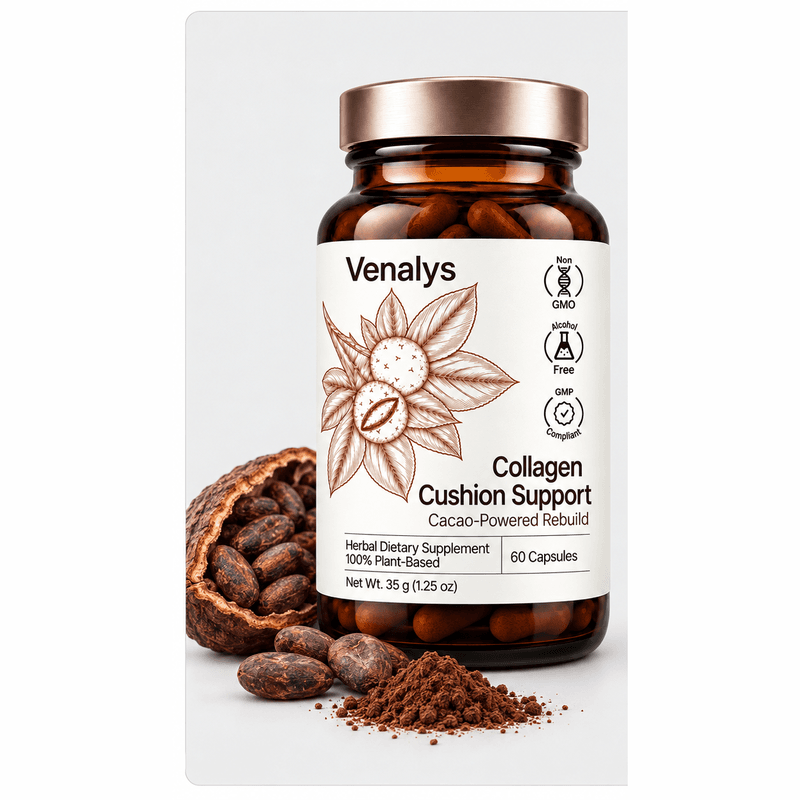
About Venalys
Venalys Collagen Cushion Support is a daily, plant based capsule made with cacao, horse chestnut, butcher's broom, soft psyllium and chicory root. It is formulated to support healthy vein tone and comfortable, regular bowel movements.†
Learn more about Venalys†These statements have not been evaluated by the Food and Drug Administration. This product is not intended to diagnose, treat, cure, or prevent any disease.
FAQs
What is a collagen supplement good for?
Most research looks at skin, with some studies on joints. Many of those trials were small and often paid for by collagen makers. None of them studied hemorrhoids.
Why do people take a collagen supplement?
Mostly for skin, joints, hair and nails, often because collagen production drops with age. Some take it as an easy extra source of protein. It's worth knowing what you expect it to change before you start.
What is a good collagen supplement to take?
Look for a clear label: the animal source, the grams of collagen per serving and a short ingredient list. Extras don't make a product better. If you take medication or have a health condition, ask your doctor or pharmacist first.
Is a collagen supplement just protein?
Yes, it's a protein, but an unusual one. It's rich in a few amino acids, like glycine and proline, and it's missing one your body needs from food. So it doesn't count as a complete protein the way eggs or meat do.
Is gelatin the same as a collagen supplement?
They come from the same material. Gelatin is collagen in long chains, so it sets when it cools. Collagen peptides are gelatin cut into short pieces, so they dissolve in a drink.
Is there a plant based collagen supplement?
No. Plants don't make collagen, so every true collagen supplement comes from an animal. Products called vegan collagen usually contain amino acids and vitamin C instead.
Can a collagen supplement help hemorrhoids?
No study has tested it. The cushions do contain collagen, but swallowed collagen is broken down and used across the whole body. Fiber, water and less straining have much better evidence.