

Table of Contents
- Collagen supplement side effects: the short list
- Side effects of collagen supplements on your gut
- Why gut side effects matter more with hemorrhoids
- Collagen dietary supplement side effects that come from the label
- Collagen supplement risks: who should check with a doctor first
- Side effect of taking collagen supplement every day: what to try
- When the problem isn't the collagen
- Sources
- About Venalys
Yes, a collagen supplement can have side effects, but for most people they're mild and stay in the gut: a heavy stomach, bloating, heartburn, a strange aftertaste, and changes in your stools. If you have hemorrhoids, those stool changes are the part to watch, and our guide to collagen for hemorrhoids explains why the cushion cares about collagen in the first place.
Maybe you stir a scoop into your coffee every morning. Your stomach feels a little full by nine. And lately your mornings in the bathroom take longer than they used to. You wonder if it's the powder. It might be. Here's what's worth knowing.
Collagen supplement side effects: the short list
Collagen is a protein, and most people handle it about as well as any other protein. When people do report problems, they tend to fall into a few groups:
- A full or heavy stomach, sometimes with burping
- Bloating and gas
- Heartburn, especially when you take it on an empty stomach
- An odd taste in your mouth that lingers
- Harder stools for some people, looser stools for others
- Rarely, an allergic reaction, like a rash or itching
A lot of these don't come from the collagen itself. They come from the size of the serving or from what else is in the tub. We'll get to the label in a minute.
No number on this list comes with a promise. There's no good research that tells you how often each one happens. So treat it as a list of things to notice, not odds.
Side effects of collagen supplements on your gut
Your gut is where collagen does most of its arguing. Here are the three complaints you'll hear about most.
Constipation and harder mornings
Collagen is protein with no fiber in it. That's fine on its own. The trouble starts when a collagen shake takes the place of breakfast. You lose the oatmeal, the fruit, the glass of water. Your day ends up with less fiber and less fluid, and you may not notice.
Less fiber usually means harder stools. Harder stools mean more pushing. Cleveland Clinic lists straining as one of the main causes of hemorrhoids, and it suggests 25 to 38 grams of fiber a day. A protein shake doesn't count toward that number.
Loose stools
Some people go the other way. Loose stools often come from sweeteners in flavored powders and gummies, especially sugar alcohols. Their names usually end in "ol", like sorbitol or erythritol. A big serving all at once can do it too, and so can a sensitive gut.
Fullness, bloating and heartburn
A heaping scoop on an empty stomach is a lot of protein to hit at once. Some people feel full, gassy or a little burned behind the breastbone. Taking it with a meal, or splitting it into two smaller servings, often makes a difference.
Why gut side effects matter more with hemorrhoids
For most people, a bit of constipation or a few loose days is just annoying. For you, it's different. Both put extra load on the cushions.
Here's the background. Everyone has hemorrhoidal cushions. In a 2015 study, surgeons at Cleveland Clinic Florida found that hemorrhoid tissue had less of the strong type I collagen compared with the stretchier type III. The authors concluded the tissue seems less stable. That study doesn't say collagen powder causes anything. It does tell you the tissue you're dealing with is less forgiving.
So when a shake leaves you straining, that pressure lands on tissue that's already weaker. And when sweeteners send you running to the bathroom again and again, all that wiping and sitting irritates the same spot.
That's why the basics still come first. The American Society of Colon and Rectal Surgeons calls fiber, fluids and exercise the cornerstone of hemorrhoid care. Any supplement that pushes those out of your day is working against you. If you also take a fiber supplement, psyllium husk side effects are a separate topic, and they're worth reading about too.
Collagen dietary supplement side effects that come from the label
Turn the tub around. A lot of side effects hide on the back.
The source animal. Almost all collagen comes from animals. Marine collagen comes from fish skin and scales, so people with a fish or shellfish allergy should skip it. Some products use eggshell membrane, which matters if you're allergic to eggs. If you avoid beef or pork for health or faith reasons, check which animal it came from.
The extras. Many powders add sweeteners, flavors, vitamin C, biotin or hyaluronic acid. Each one is another thing your body has to handle. If you get a reaction, it can be hard to tell which ingredient caused it. A plain powder with one ingredient makes that much easier.
The word "natural". MedlinePlus, the National Library of Medicine's health site, reminds readers that herbal products don't go through the testing that drugs do, and that "natural" doesn't always mean safe. The same thinking applies to any supplement on the shelf. Quality depends on the company that makes it.
Collagen supplement risks: who should check with a doctor first
Collagen isn't a risky product for most healthy adults. But a few people should ask before they start:
- Anyone told to limit protein. That includes people with kidney disease and some people with gout. Collagen adds protein to your day, even if it doesn't feel like food.
- Anyone on regular medicines. MedlinePlus notes that some herbal products interact with prescription and over the counter medicines. Show your doctor or pharmacist everything you take, collagen included.
- Anyone with food allergies. Fish, shellfish and eggs are the big ones to check against the source.
- Anyone stacking several supplements. Three powders and two capsules a day is a lot of extras to keep track of.
Whether collagen actually helps your skin, joints or anything else is a different question. This page is only about what can go wrong.
Side effect of taking collagen supplement every day: what to try

If you take collagen daily and something feels off, you don't have to guess. Try this, one step at a time:
- Take it with a meal instead of on an empty stomach.
- Cut the serving in half for a week and see if things settle.
- Switch to a plain, unflavored powder with no sweeteners.
- Don't let it replace breakfast. Keep your fiber foods and drink a full glass of water with it.
- Stop it for a week or two. If the problem goes away, you have your answer.
Stop right away and get help if you notice swelling of your lips, tongue or face, hives, or trouble breathing. That's an allergic reaction, not a stomach issue.
When the problem isn't the collagen
It's easy to blame the newest thing in your cabinet. Sometimes that's right. Sometimes it isn't.
See your doctor if you have rectal bleeding, severe pain, a lump that doesn't go away, or a change in your bowel habits that lasts. Don't assume those are a side effect of a powder, and don't assume bleeding is just hemorrhoids. Only an exam can tell you what's going on.
Sources
- Nasseri and colleagues, Cleveland Clinic Florida, 2015, collagen in hemorrhoid tissue
- Cleveland Clinic, Hemorrhoids
- American Society of Colon and Rectal Surgeons, Hemorrhoids
- MedlinePlus, National Library of Medicine, Herbal Medicine
This article is for general information and is not medical advice. If you have rectal bleeding, severe pain or a change in your bowel habits, see your doctor.
About Venalys
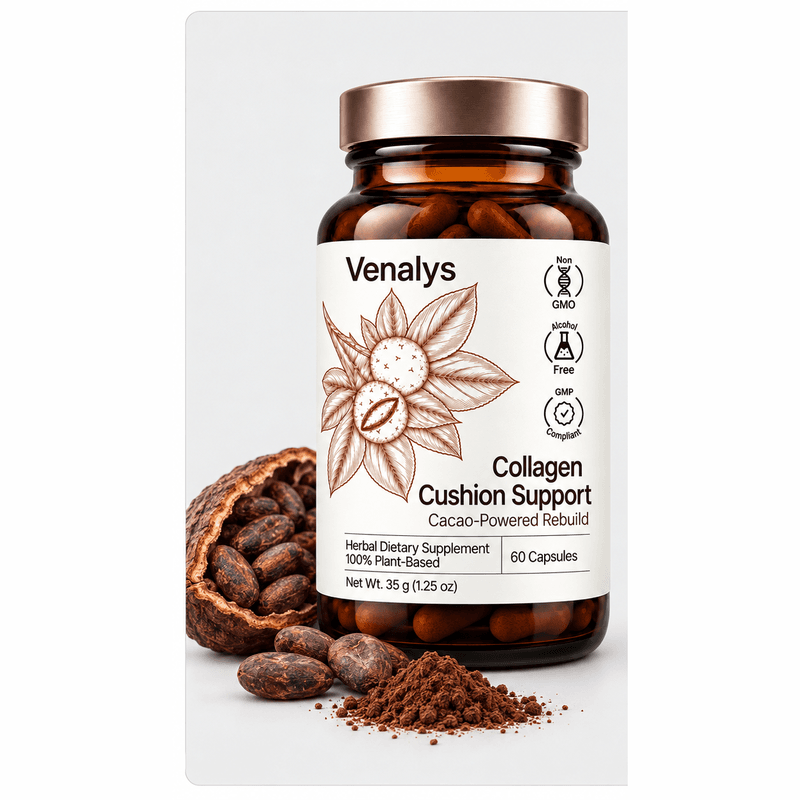
Venalys Collagen Cushion Support is a daily, plant based capsule made with cacao, horse chestnut, butcher's broom, soft psyllium and chicory root. It is formulated to support healthy vein tone and comfortable, regular bowel movements.†
Learn more about Venalys†These statements have not been evaluated by the Food and Drug Administration. This product is not intended to diagnose, treat, cure, or prevent any disease.
FAQs
Does a collagen supplement have side effects?
It can. Most are mild and digestive, like fullness, bloating, heartburn or a change in your stools. Allergic reactions are rare and usually tied to the source animal or an added ingredient.
Can collagen make hemorrhoids worse?
There's no evidence that collagen itself causes hemorrhoids. But if a collagen shake leaves you constipated and straining, or gives you loose stools, that's extra load on the cushions. Keep your fiber and water steady.
Do collagen side effects go away?
Mild stomach complaints often settle when you take it with food, lower the serving or stop it. If a problem keeps going after you stop, it's probably not the collagen. Talk with your doctor.
Is collagen hard on your kidneys?
For people with healthy kidneys, collagen is just another source of protein. If you have kidney disease or your doctor told you to limit protein, ask before you start.
Can you take collagen and fiber together?
Yes. Taking them at the same meal with a full glass of water is a simple way to keep collagen from crowding fiber out of your day.