
Table of Contents
- What is psyllium husk
- Psyllium husk benefits
- How psyllium helps with hemorrhoids
- Psyllium husk powder, whole husk and capsules
- The psyllium family, question by question
- Psyllium husk supplement
- Fiber supplements with psyllium husk
- What is psyllium husk powder
- Is psyllium husk insoluble fiber
- Is psyllium husk a prebiotic
- Psyllium fiber supplement for constipation
- How much psyllium husk per day
- How many psyllium capsules per day
- Can I take psyllium husk daily
- How long does psyllium husk take to work
- Psyllium husk side effects
- Is psyllium husk safe
- Sources
- About Venalys
Psyllium husk is a soluble fiber that turns into a soft gel with water, so stools come out easier and you don't have to push. That's its biggest benefit for hemorrhoids, and it's one of the best studied fibers you'll see listed on a hemorrhoid supplement label.
You know the mornings we're talking about. You sit down, you wait, you push a little, then a little more. You stand up and feel it for the rest of the day. Here's the thing. That push isn't a small thing for the tissue down there.
Everyone has hemorrhoidal cushions, normal pads of collagen, elastin and blood vessels. Harvard Health explains that the tissue holding them in place can weaken with age. And a 2015 study from Cleveland Clinic Florida found a weaker mix of collagen in hemorrhoid tissue. Straining adds pressure to tissue whose support is already weaker.
What is psyllium husk
Psyllium husk is the thin outer coat of the seeds of a plant called Plantago ovata, grown mostly in India. The husk is almost all fiber. Most of it is soluble, which means it soaks up water.
Here's how it works. Stir it into a glass of water and within a minute it thickens. In your gut it does the same thing. It holds water inside the stool, so the stool stays soft and moves along without a fight. Fiber researchers point out a neat twist. Psyllium can soften hard stools and also firm up loose ones. It brings things toward the middle.
Psyllium husk benefits
Doctors mention fiber first for hemorrhoids, and psyllium is the fiber they name most. The current guideline from the American Society of Colon and Rectal Surgeons found that fiber cut persistent hemorrhoid symptoms by 53 percent, as summarized in American Family Physician in 2025. An earlier American Family Physician review reported that fiber supplements cut bleeding by about half.
The Cleveland Clinic Journal of Medicine goes further. It strongly recommends fiber, at least 28 grams a day for women and 38 for men, and names psyllium husk as a way to fill the gap.
Other benefits people look for:
- Regular, softer bowel movements, without the urgency of a stimulant laxative.
- Calmer loose stools, since the gel holds extra water.
- A gut that feels more settled, because fiber feeds the bacteria living there.
- Help with cholesterol and blood sugar, which is why your doctor may bring it up for your heart too.
- Feeling full longer after a meal.
How psyllium helps with hemorrhoids
This is where most articles stop at "good for digestion". For hemorrhoids, the real job is pressure. Every time you strain, the cushion gets pushed down and the vessels inside fill up. Do that every morning for years and the tissue never gets a break.
That's the point of psyllium for hemorrhoids. You don't want bigger stools. You want softer ones that pass with no push. That takes daily pressure off the cushions.
Be clear on one thing, though. Fiber eases the pressure. It doesn't change the tissue itself, and it won't make a hemorrhoid that's already there go away. If symptoms keep coming back, see your doctor.
Psyllium husk powder, whole husk and capsules

You'll find psyllium in three main forms. Whole husk looks like light flakes and is the least processed. Powder is the husk ground fine, so it mixes faster and thickens quicker. Capsules hold powder inside a shell, so there's no taste and no glass to stir.
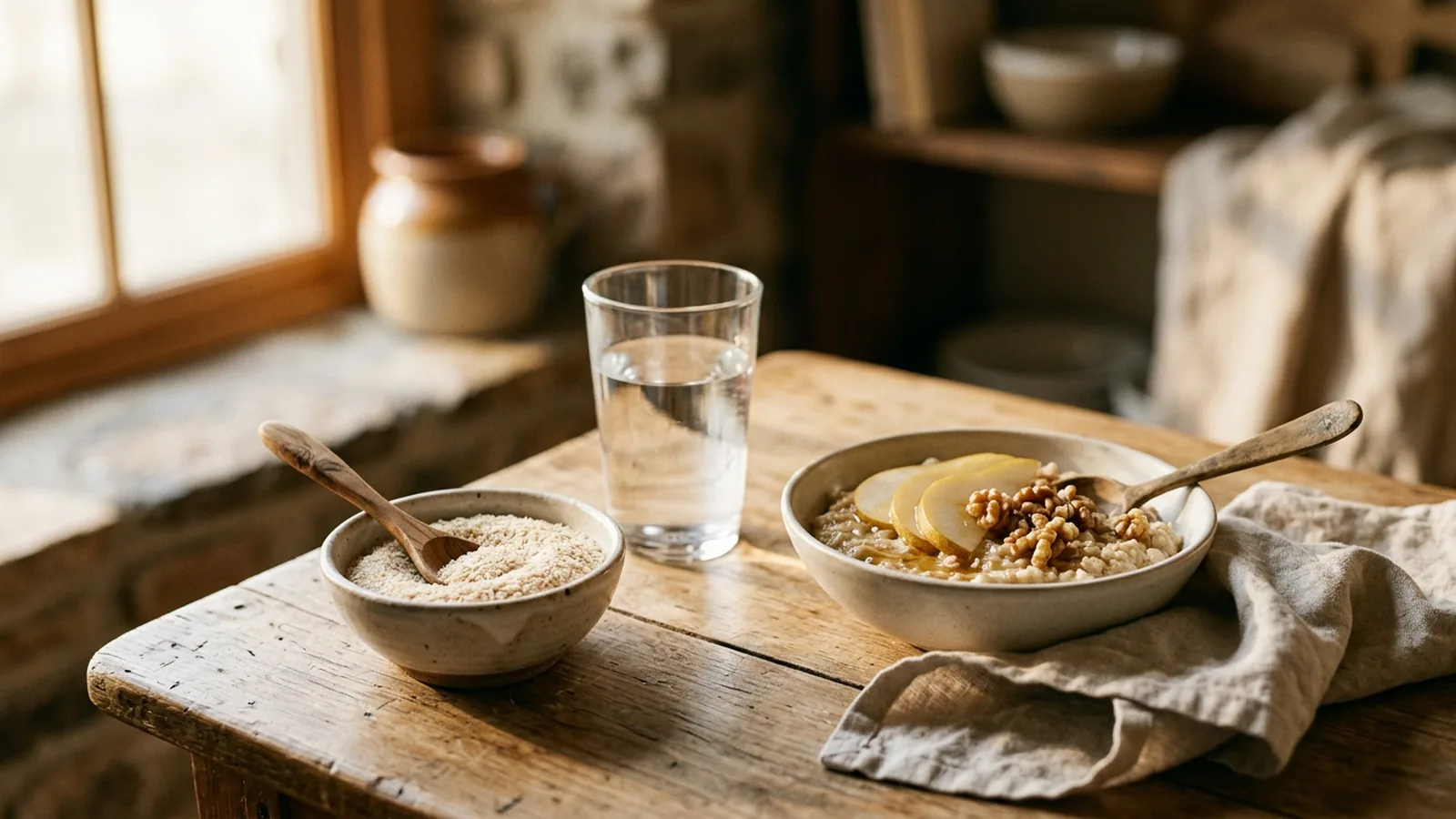
People use it in water or juice, stirred into oatmeal or yogurt, or baked into bread, where it helps hold gluten free dough together. "Organic" on the label tells you how the plant was grown. It doesn't change how the fiber works.
The psyllium family, question by question
Psyllium husk supplement
A psyllium husk supplement is simply the husk sold on its own, as powder, flakes or capsules. Some add flavor or sweeteners. Read the label for the grams of fiber per serving and anything else in there. Plain is usually the gentlest choice.
Fiber supplements with psyllium husk
Many drugstore fiber supplements use psyllium as the main ingredient. Others use wheat dextrin, methylcellulose or inulin. These fibers act differently. Psyllium forms a thick gel and holds water, which is what softens stools. Some other fibers dissolve without gelling and do less for stool form. If softness is your goal, check which fiber is actually listed.
What is psyllium husk powder
Psyllium husk powder is the same husk, milled into a fine dust. Because there's more surface area, it grabs water faster. That makes it easy to mix but also quick to turn thick, so drink it right after stirring. A spoon of powder carries more fiber than the same spoon of whole flakes, since it packs tighter.
Is psyllium husk insoluble fiber
Mostly no. Psyllium husk is mainly soluble fiber, the kind that soaks up water and forms a gel. It does contain a smaller insoluble part, the kind that adds roughness. That mix is why psyllium softens stool without making it scratchy. If you've had a bad time with bran or other rough fibers, psyllium often feels gentler.
Is psyllium husk a prebiotic
Partly. A prebiotic is a fiber your gut bacteria eat. Psyllium is only lightly fermented, so it feeds bacteria less than fibers like chicory root inulin. That's actually a plus for some people, since it causes less gas. Its main strength is holding water, not feeding bacteria. Think of it as a gentle helper for your gut, not a full prebiotic.
Psyllium fiber supplement for constipation
For constipation, psyllium is one of the first things doctors suggest, before stronger laxatives. It works by keeping water in the stool, so it doesn't dry out and harden. It needs water to work. Take it with a full glass, and keep drinking through the day. Without enough water, fiber can make constipation worse.
How much psyllium husk per day
Start low. Many people begin with half the serving on the label and add a little every few days. The goal is your total fiber for the day, from food and supplement together. US reviews suggest 25 to 35 grams a day of fiber for hemorrhoids. Most of that should still come from food.
How many psyllium capsules per day
Capsules hold much less psyllium than a spoon of powder, so it takes several of them to match one serving. That's why one capsule often seems to do nothing. Follow the label, take each dose with a full glass of water, and build up slowly. If you need a lot of capsules, powder may be easier.
Can I take psyllium husk daily
Yes, most people can take psyllium every day. Daily is where it does its best work, because the cushion needs soft mornings every morning, not once in a while. Drink enough water, keep your other medicines a couple of hours apart, and tell your doctor if you have trouble swallowing or a history of bowel blockage.
How long does psyllium husk take to work
Psyllium isn't a same day laxative. It works by changing your stool over time, so give it steady daily use before you judge it. Your gut also needs time to adjust to more fiber, which is when gas and bloating show up. If nothing changes after a few weeks, talk to your doctor.
Psyllium husk side effects
The most common side effects are gas, bloating and a full feeling, mostly in the first weeks. Going slow helps. Taken with too little water, psyllium can clump and, rarely, block the throat or bowel. Some people are allergic to it, especially those who handle the powder a lot. Stop and get help if you have trouble breathing or swallowing.
Is psyllium husk safe
For most adults, yes, when taken with plenty of water. It's been used for decades. Take other medicines a couple of hours before or after, since fiber can slow how they're absorbed. Pick a brand checked by an outside lab. Ask your doctor first if you have diabetes, a bowel narrowing, or trouble swallowing.
Sources
- Harvard Health Publishing, Hemorrhoids and what to do about them
- Nasseri and colleagues, Cleveland Clinic Florida, 2015, collagen in hemorrhoid tissue
- American Family Physician, 2025 summary of the ASCRS hemorrhoid guideline
- Mott and colleagues, American Family Physician, 2018, Hemorrhoids: diagnosis and treatment options
- Cengiz and Gorgun, Cleveland Clinic Journal of Medicine, 2019, Hemorrhoids: a range of treatments
This article is for general information and is not medical advice. If you have rectal bleeding, severe pain or a change in your bowel habits, see your doctor.
About Venalys
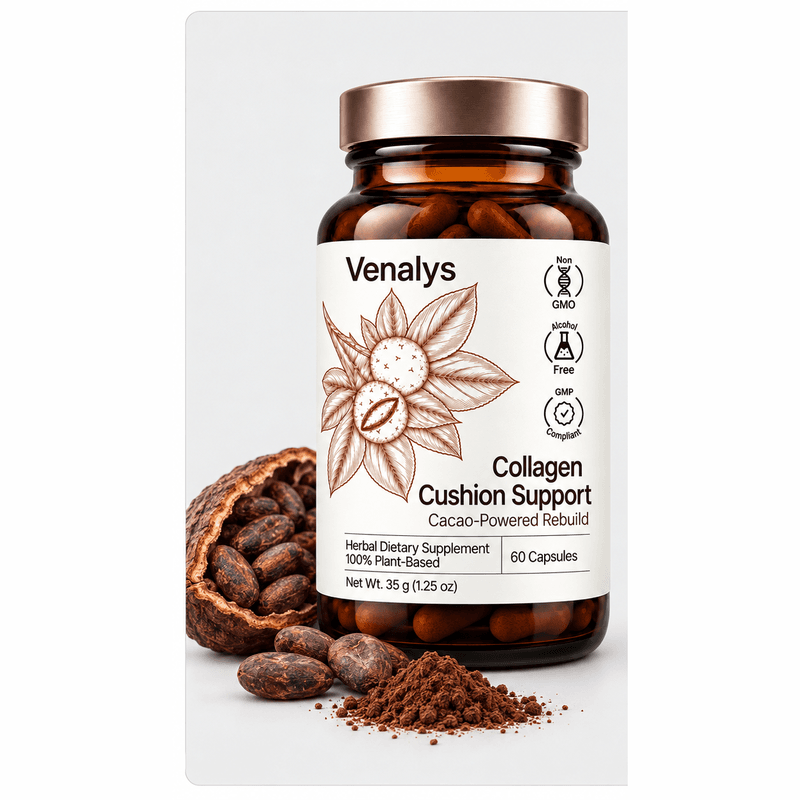
Venalys Collagen Cushion Support is a daily, plant based capsule made with cacao, horse chestnut, butcher's broom, soft psyllium and chicory root. It is formulated to support healthy vein tone and comfortable, regular bowel movements.†
Learn more about Venalys†These statements have not been evaluated by the Food and Drug Administration. This product is not intended to diagnose, treat, cure, or prevent any disease.
FAQs
How do I take psyllium husk for hemorrhoids?
Mix one serving in a full glass of water or juice and drink it right away. Start with half a serving, add more slowly, and keep drinking water through the day. Take it at the same time each day. Pair it with short bathroom visits and no straining.
Is it good to have psyllium husk every day?
For most people, yes. Steady daily use keeps stools soft, which matters more than an occasional big dose.
What is the downside of taking psyllium?
Gas and bloating at first, a thick texture some people dislike, and the need for plenty of water. It can also slow how other medicines are absorbed.
Which is better, chia seeds or psyllium husk?
Both form a gel. Psyllium is more concentrated fiber and has better evidence for stool form and hemorrhoids. Chia is a food with fat and protein too. You can enjoy both.
What should I not mix with psyllium husk?
Don't take it at the same time as your medicines or supplements. Space them a couple of hours apart. Don't take it dry or with just a sip of water.