

Table of Contents
Internal hemorrhoids are swollen cushions of blood vessels inside the lower rectum, above the spot where you have pain nerves. That's why their most common sign is bright red blood after a bowel movement with no pain at all, and why they're the most confusing of all the hemorrhoid symptoms.
Maybe you saw red on the paper this morning. Nothing hurt. So you told yourself it was nothing and went on with your day. Then it happened again a few weeks later. You're not alone in that pattern, and it's worth understanding what's going on.
Everyone has these cushions. They're a normal part of your body. Harvard Health explains that the tissue that holds them in place can weaken with age. When it does, the cushions swell and slide down under daily pressure, and that's when they start to cause trouble.
What internal hemorrhoids are
Near the very end of your bowel, there's a line where the inner lining meets the skin. Doctors call it the dentate line. A 2018 review in American Family Physician explains that internal hemorrhoids sit above that line. The lining there has no nerves that feel pain, which is why these hemorrhoids usually don't hurt.
External hemorrhoids are the other kind. They sit below the line, under skin that does feel pain. That's a separate topic with its own page. Here, we stay inside.
Internal hemorrhoids can do three main things. They can bleed. They can let out a little mucus. And they can slide out of the opening, which doctors call prolapse. Most of what follows comes back to one of those three.
Where they sit and what they look like
Internal hemorrhoid diagram, in words
Picture a short tube. At the top is the rectum, lined with soft, moist tissue. At the bottom is the opening, covered with skin. The dentate line runs around the tube between the two. Internal hemorrhoids are soft pads just above that line, inside the tube. You can't see them, and you usually can't feel them. External hemorrhoids sit lower, at the rim, under the skin. When a drawing shows a bulge high inside the tube, that's an internal one. When it shows a lump at the outer edge, that's external.
Hemorrhoids external photos: what you can actually see
A lot of people search for photos to compare with what they see in a mirror. Here's the catch. The Cleveland Clinic notes that you won't see an internal hemorrhoid unless it slides out. So if you see a lump at the opening, it's either an external hemorrhoid or an internal one that has come out. Photos can't tell you which, and they can't rule out other things. A doctor can tell with a short, gentle exam.
Prolapsed internal hemorrhoids images
When an internal hemorrhoid comes out, it often looks like a small, soft, moist bump, a bit like a grape. It's covered by the soft inner lining, not by skin. The Cleveland Clinic describes it as a small lump that you can often push back in. If the lump is hard, dark, very painful or won't go back, that's a different picture. See your doctor soon.
Internal hemorrhoid symptoms, one at a time
What are internal hemorrhoid symptoms
The NIH lists two main signs: bright red blood on your stool, on the toilet paper or in the bowl after a bowel movement, and a hemorrhoid that comes out of the opening. American Family Physician adds soiling, itching and a soft tissue bulge. You may have one sign, or a few at once.
Are internal hemorrhoids painless
Most of the time, yes. Harvard Health says internal hemorrhoids are typically painless, even when they bleed. Dr. Dave Longcope, a colorectal surgeon in Denver, explains in a patient video that "the skin has nerve endings that can feel pain whereas the mucosa does not." But he also warns that "internal hemorrhoids can hurt and external hemorrhoids can sometimes be painless." The NIH notes that internal hemorrhoids that slide out may cause pain. If you have real pain, don't assume it's an internal hemorrhoid. A fissure or an abscess can feel similar.
Can internal hemorrhoids leak mucus
Yes. Harvard Health explains that a hemorrhoid that slides out can collect small amounts of mucus and tiny bits of stool. That can irritate the skin and make it itch. Wiping hard and often to stop the itch can make it worse. A gentle rinse with warm water and patting dry is easier on the skin. If the mucus is new, heavy or comes with a change in your bowel habits, mention it to your doctor.
When an internal hemorrhoid slides out
Hemorrhoid versus prolapse
These two words get mixed up. A hemorrhoid is the cushion itself. Prolapse just means sliding out of place. So a prolapsed hemorrhoid is an internal hemorrhoid that has slid down and out of the opening. Not every hemorrhoid prolapses, and not everything that comes out is a hemorrhoid. A skin tag or other tissue can look like one. That's one more reason to have it looked at instead of guessing.
Prolapse or plain hemorrhoids
Some people hear "prolapse" and think it means something far worse than hemorrhoids. Often, it's simply the stage where an internal hemorrhoid has started to slip out during a bowel movement. Plain hemorrhoids that stay inside mostly bleed a little. Prolapsed ones add the feeling of a bump, some mucus and itching. Both are the same cushion. The difference is how far its support has let it slide.
Prolapsed hemorrhoid external
An internal hemorrhoid that has come out can sit right where an external one would. That's why so many people think they have an external hemorrhoid when they don't. A few clues help. An internal one that has slipped out is soft, moist and often goes back in on its own or with a gentle push. An external one sits under the skin and doesn't go back up, because it already belongs outside. A sudden, hard, very painful lump is more likely a clot, which is covered on another page.
Stages, size and how they start
Internal hemorrhoid disease and its four grades
Doctors grade internal hemorrhoids from 1 to 4. American Family Physician describes them like this:
- Grade 1: the cushion bulges inside but doesn't come out.
- Grade 2: it comes out when you go, then slips back on its own.
- Grade 3: it comes out and you have to push it back in.
- Grade 4: it stays out and can't be pushed back.
Most people with internal hemorrhoids never need surgery. In a short patient video from Providence Swedish, the doctor puts it simply: "rarely do patients need surgery for hemorrhoids." Fiber, water and office procedures come first.
Medium sized internal hemorrhoids
Here's something most pages skip. The grades only measure how far a hemorrhoid slides out. The same American Family Physician review points out that the system leaves out size, number, bleeding and pain. So "medium sized" isn't an official stage. A large cushion that stays inside is still grade 1. A smaller one that drops out each time can be grade 2 or 3. What matters for you is how it behaves, not how big it looks.
How do you get an internal hemorrhoid
Pressure, mostly. Straining, hard stools, long visits to the toilet and heavy lifting push down on the cushions again and again. Dr. Longcope explains that "internal hemorrhoids usually develop slowly over years," while external ones can show up in hours. So the flare you noticed this week probably started long before. It's the result of many small hard mornings landing on support that has grown looser.
Settling down, or time to worry
How to tell if internal hemorrhoids are healing
You can't see inside, so you go by signs. A flare that is settling down usually bleeds less often, then stops. The bump comes out less, or not at all. The itching fades. The Cleveland Clinic says symptoms may last about a week or a little longer. If nothing improves after a week of soft stools, more water and less straining, see your doctor. And remember that a calm week doesn't mean the cushion is back to how it was years ago.
When to worry about a hemorrhoid
Bleeding is the big one. The American Cancer Society explains that rectal bleeding, blood in the stool and changes in bowel habits can also be signs of colorectal cancer, and that hemorrhoids can cause the same signs. Only a doctor can tell them apart. American Family Physician advises a full colon check for people over 40 with rectal bleeding, unless they had a normal one in the last 10 years. Get care right away for heavy bleeding, severe pain, or a hemorrhoid that stays out and hurts.
When they keep coming back

Many flares calm down within a week or so. But if yours return every few weeks, the question isn't really this flare anymore. It's the support around the cushion. Each round of pressure lands on tissue that holds a little less well than it used to. That's why the habits that lower daily pressure matter between flares, not just during them: soft stools, enough water, short bathroom visits and regular movement. And if the pattern keeps repeating, it's a good reason to talk with your doctor about what grade you have and what your options are.
Sources
- Harvard Health Publishing, Hemorrhoids and what to do about them
- Mott, Latimer and Edwards, American Family Physician, 2018, Hemorrhoids: diagnosis and treatment options
- Cleveland Clinic, Hemorrhoids
- NIDDK (NIH), Symptoms and causes of hemorrhoids
- American Cancer Society, Signs and symptoms of colorectal cancer
- Dr Dave Longcope, The Truth About Hemorrhoids: Separating Fact from Fiction (YouTube)
- Providence Swedish, Symptoms of Hemorrhoids (YouTube)
This article is for general information and is not medical advice. If you have rectal bleeding, severe pain or a change in your bowel habits, see your doctor.
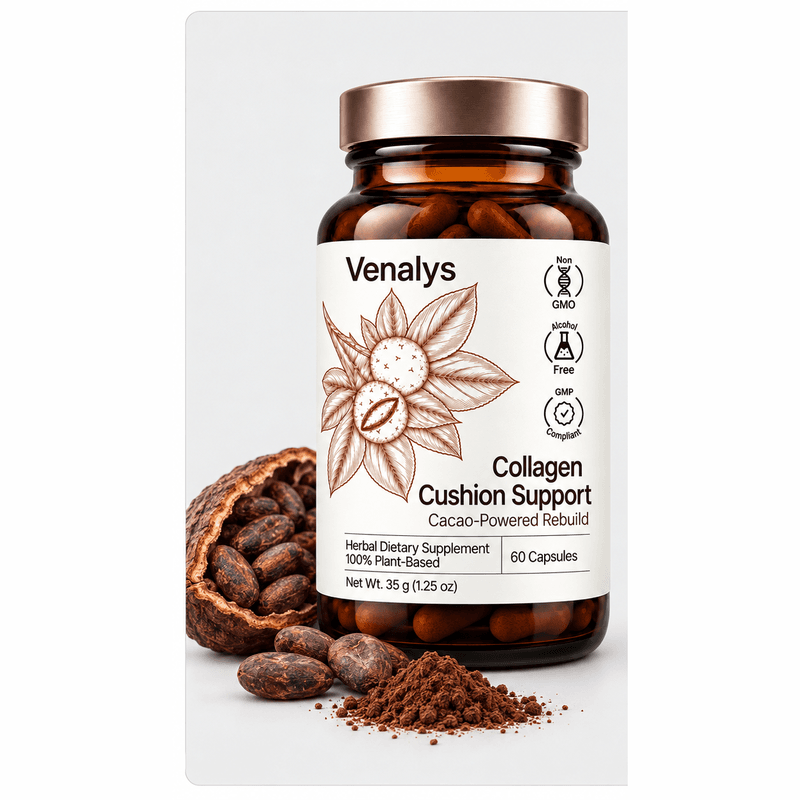
About Venalys
Venalys Collagen Cushion Support is a daily, plant based capsule made with cacao, horse chestnut, butcher's broom, soft psyllium and chicory root. It is formulated to support healthy vein tone and comfortable, regular bowel movements.†
Learn more about Venalys†These statements have not been evaluated by the Food and Drug Administration. This product is not intended to diagnose, treat, cure, or prevent any disease.
FAQs
Do internal hemorrhoids go away on their own?
Flares often settle within a week or so with soft stools and less straining. The cushion itself stays, because it's a normal part of your body. That's why symptoms can return.
What can be mistaken for internal hemorrhoids?
Fissures, polyps, an abscess and colorectal cancer can cause similar signs, especially bleeding. That's why any rectal bleeding deserves a visit to your doctor.
How do doctors check for internal hemorrhoids?
They look at the area and use an anoscope, a short lighted tube, to see inside. It takes a moment. If you're bleeding, they may also suggest a colonoscopy.
Can you feel an internal hemorrhoid?
Usually not, while it stays inside. You may feel a soft bump when it slides out during a bowel movement.
Should you push an internal hemorrhoid back in?
A soft one that slipped out can often be pushed back gently with a clean finger. If it won't go back or it hurts a lot, see your doctor.
Do internal hemorrhoids always need surgery?
No. Most people do well with fiber, water and better bathroom habits. Office procedures like banding come next. Surgery is mostly kept for grade 3 or 4 hemorrhoids, or ones that keep coming back.